Dunkelflaute and Kühlkraftkrise: how the weather sets the price of energy
Little wind and sun in winter, a heat wave with cooling at full capacity in summer: the weather increasingly sets the price of electricity. What are a Dunkelflaute and a Kühlkraftkrise, what did the June 2026 heat wave teach us, and why is the timing of your consumption becoming as important as the volume?

Dunkelflaute, Kühlkraftkrise… In recent years, the energy market has picked up a rather striking vocabulary. Behind these terms lie weather conditions that can have a major impact on electricity prices. What exactly do they mean? And more importantly, how do they affect your business?
Winter: the Dunkelflaute
A Dunkelflaute is a period with barely any wind and very little sunshine. Wind and solar power largely drop out at the same time. To make up for the difference, other energy sources have to step in. These are often gas-fired power plants, which then help set the price on the wholesale market.
A Dunkelflaute usually lasts a few days and can occur several times a year. That does not mean the lights suddenly go out. Cross-border exchanges within Europe, reserve capacity, and flexibility in the energy system help keep supply and demand in balance. But electricity prices can rise sharply during such a period.
Summer: the Kühlkraftkrise
In summer, almost the opposite can happen. That is when another term comes up: the Kühlkraftkrise.
On very hot, sunny days, solar output is high during the day. As a result, electricity prices can drop sharply and sometimes even turn negative. But as soon as the sun sets, that output falls off quickly. Meanwhile, electricity demand stays high, partly because air conditioners and other cooling systems keep running at full capacity.
The result is a sharp reversal: cheap solar power disappears, and more expensive energy sources, such as gas-fired plants, have to take over. Within just a few hours, electricity prices can climb steeply.
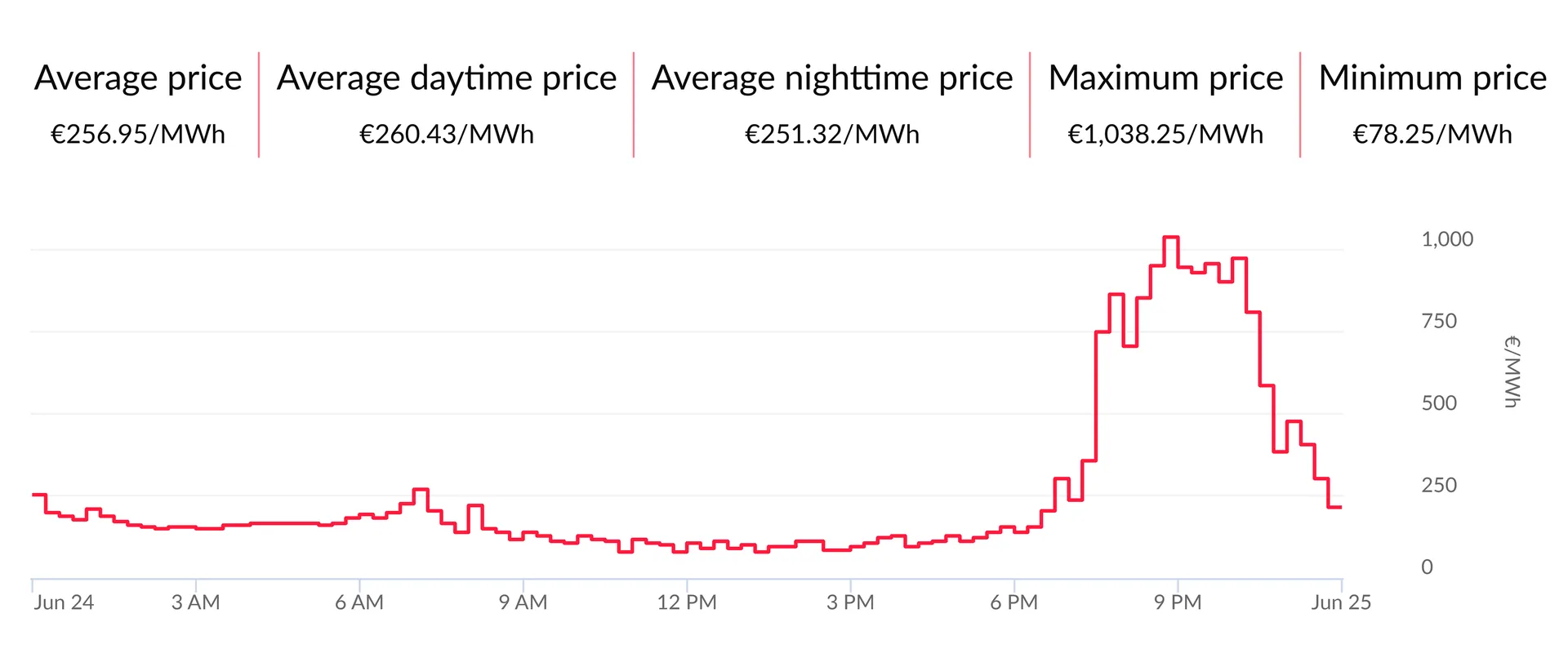
In late June 2026, we saw this play out very clearly. During an intense heat wave in Belgium, abundant solar output pushed daytime prices toward zero. In the evening, the picture flipped completely. As soon as solar generation dropped away, high cooling demand triggered significant price spikes.
No fewer than 28 hours saw prices above €250/MWh, each time between 6 p.m. and midnight. The highest prices occurred between 8 and 10 p.m., when high demand coincided with the loss of solar output and more expensive plants had to fill the gap.
Records fell along the way. The record for the most expensive day still stands and dates back to late August 2022, during the energy crisis. The most expensive hour and quarter-hour ever were set, however, and not at the height of a crisis, but on an ordinary summer Wednesday evening. On June 24, 2026, between 8:45 and 9:00 p.m., the price climbed to €1,038.25/MWh.
That was no fluke. Throughout the heat wave, the same pattern repeated itself evening after evening, always around the same time.
Not just how much, but above all when
For businesses, the timing of their energy consumption is becoming increasingly important. Companies that draw most of their electricity during the most expensive hours of the day pay more, even if their total consumption stays the same.
And those most expensive hours are not always where you would look for them. During the peak week in June, electricity remained more expensive during the day than many people expected, because cooling demand partly absorbed the cheap solar hours. Across the whole of June, the average nighttime price was even higher than the daytime price. The classic reflex of consuming at night because it is cheaper no longer holds true in summer.
At the same time, cheaper hours often remain underused. Think of moments with high solar or wind output, when electricity is cheap or even negatively priced. Companies that can shift part of their consumption to those hours, charge a battery, or deploy other flexible assets are far better placed to capitalize on price differences.
The Kühlkraftkrise makes this dynamic especially visible. Within a single day, the market can swing from nearly free electricity to prices of several hundred euros per MWh. Timing is therefore becoming an increasingly important part of smart energy management.
No exception
The June heat wave is not an exception but shows us what we can expect in the future. Every year, more solar panels are installed, deepening the midday price dips and sharpening the reversal at sunset. Warmer summers are making cooling a permanent factor in evening demand. And in winter, the Dunkelflaute is still lurking. Now that the market sets prices per quarter-hour, every quarter-hour counts.
For businesses, the question is shifting from "Which contract should I choose?" to "How flexible am I?" Companies that know today which part of their consumption can be shifted and which assets they can deploy will be better prepared for the next peak, whether it comes in July or in January.
To respond to price swings like these, you need to be able to connect different links in the energy value chain. That is exactly where Strado Group makes the difference. Accurate forecasting sees these peak moments coming before the market prices them in, so you can plan volumes and assets in time. Do things play out differently than the forecast? Real-time market access lets you adjust volumes at the moment it really matters. Smart steering ensures your assets respond automatically: a battery charges when power is cheap and discharges during the evening peak, and a production installation scales back when prices spike. And with a dynamic energy contract, that flexibility also shows up on your invoice.
Today, energy prices move by the quarter-hour, and that calls for an energy strategy that is just as agile. Companies that can let their consumption and assets move with the market turn these fluctuations not into a cost, but into leverage. That is why we bring every link in the chain together at Strado Group: so you no longer have to react to the peak, but are already prepared for it.

Related insights
What does one year of quarter-hour prices tell us about the Belgian energy market?
Since October 2025, each day has 96 quarter-hour prices instead of 24 hourly prices. Our analysis of the first year shows how strongly timing drives the price.
Energy prices in a volatile market
Your contract, consumption data and flexibility together determine your final energy price.
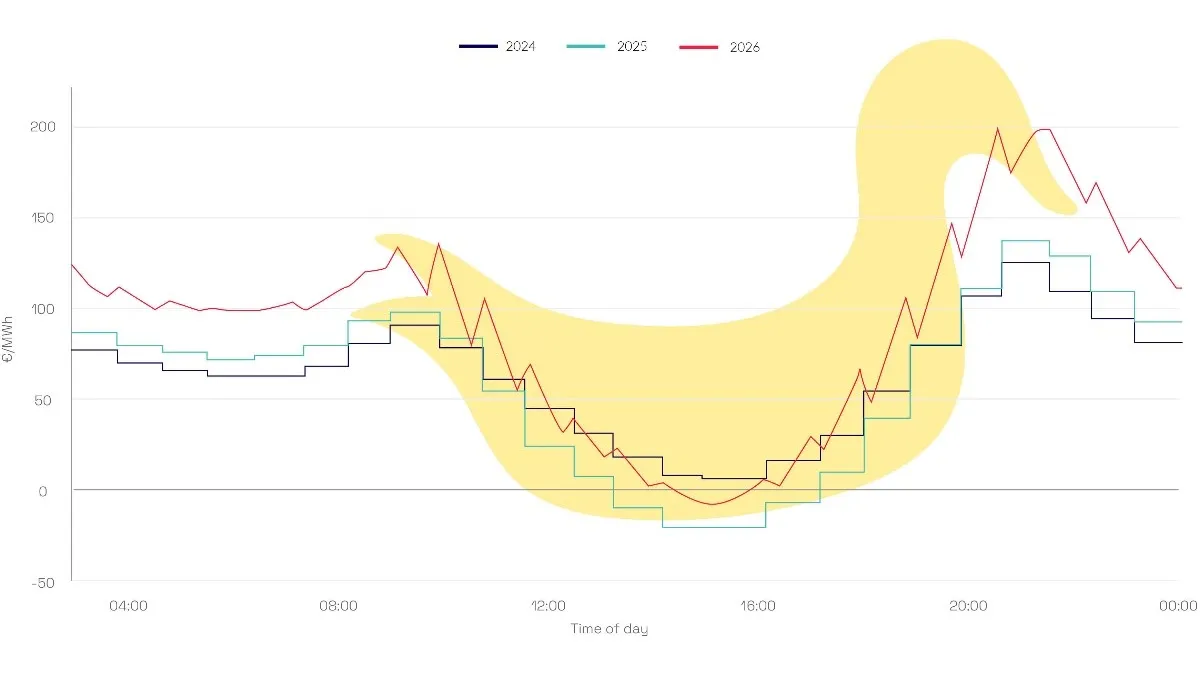
Why the duck curve is shrinking in Australia, while it's getting sharper in Europe
Batteries are flattening the duck curve in Australia and California, while price swings in Europe and Belgium keep growing. Discover why flexibility is becoming increasingly valuable and how your business can take advantage of it today.