Why the duck curve is shrinking in Australia, while it's getting sharper in Europe
In Australia, the duck curve is flattening. In Europe, and thus also in Belgium, it is getting sharper. Solar energy pushes electricity prices down during the day, then pushes them sharply back up after sunset. In California and Australia, batteries are already tempering that swing. In Europe, price fluctuations keep increasing. This contrast shows why flexibility is becoming increasingly important for businesses.

The duck curve in one picture
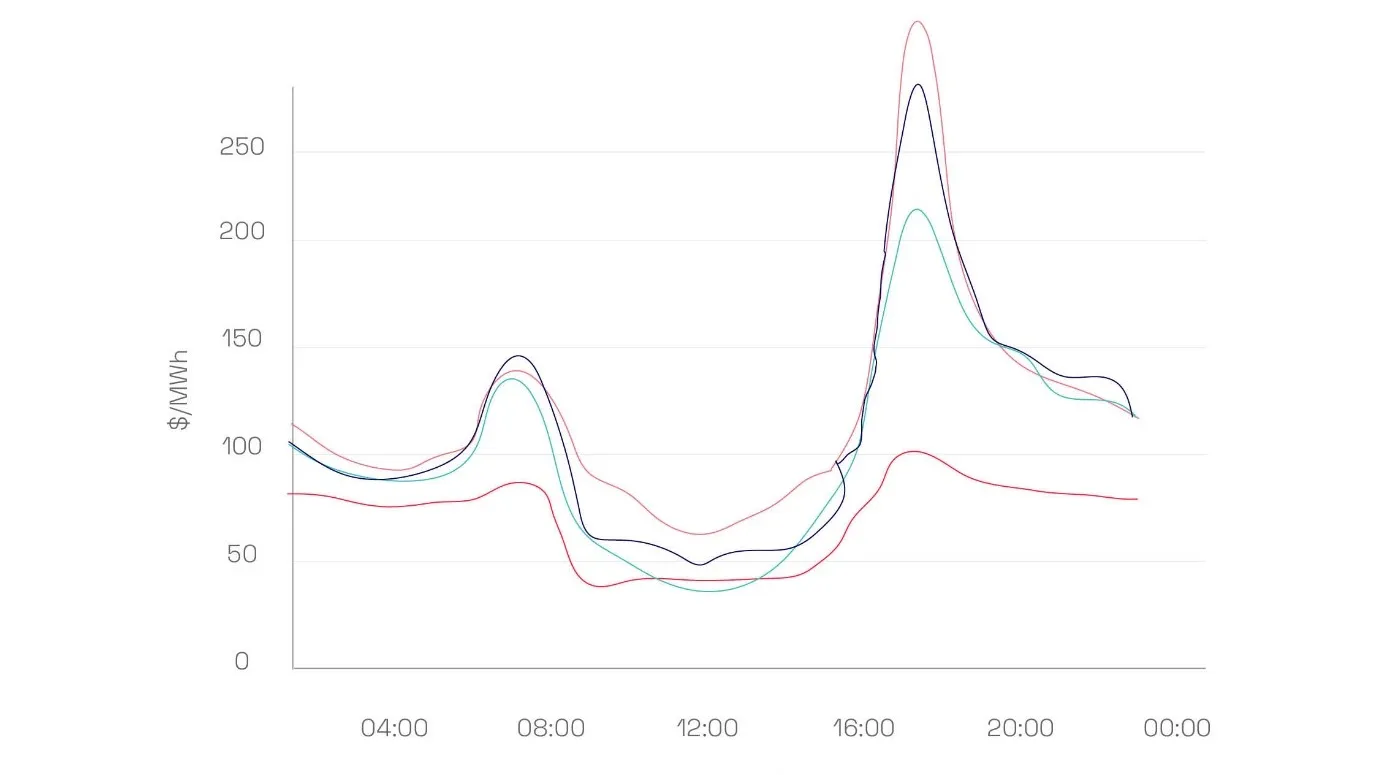
Californian grid operator CAISO introduced the term duck curve in 2013 to visualize the impact of the rapid growth of solar energy on the electricity grid. The curve shows net demand: total electricity demand minus the electricity generated by solar power at that moment.
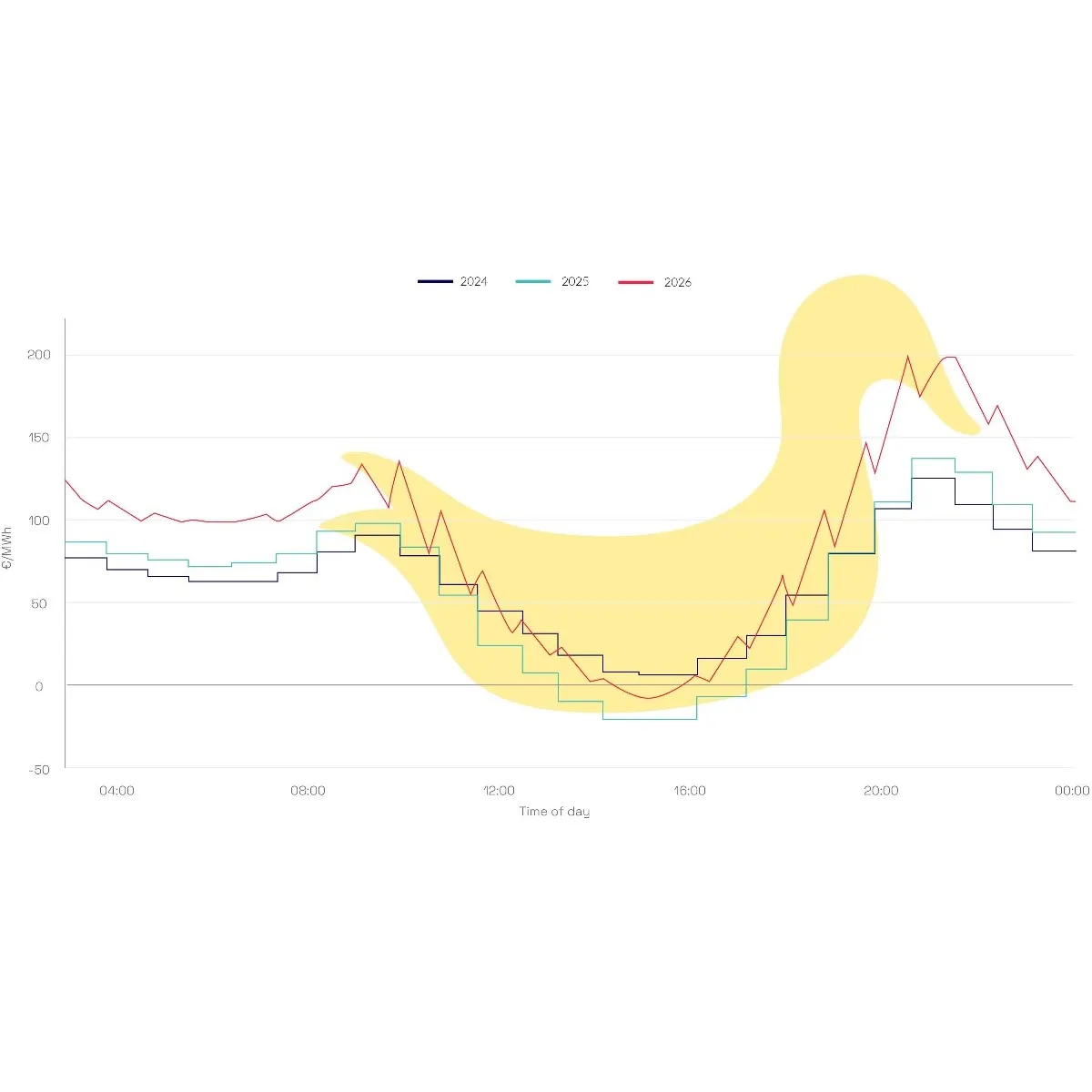
Around midday, when the sun is at its strongest, solar panels produce at full capacity, causing net demand to drop sharply. This forms the belly of the duck. As soon as the sun sets, that production quickly disappears, while demand picks up at the same time: households return home, cook using electricity and charge their cars. This rapid climb forms the neck of the duck, resulting in a sharp price spike.
Cheap midday hours and expensive evening peaks
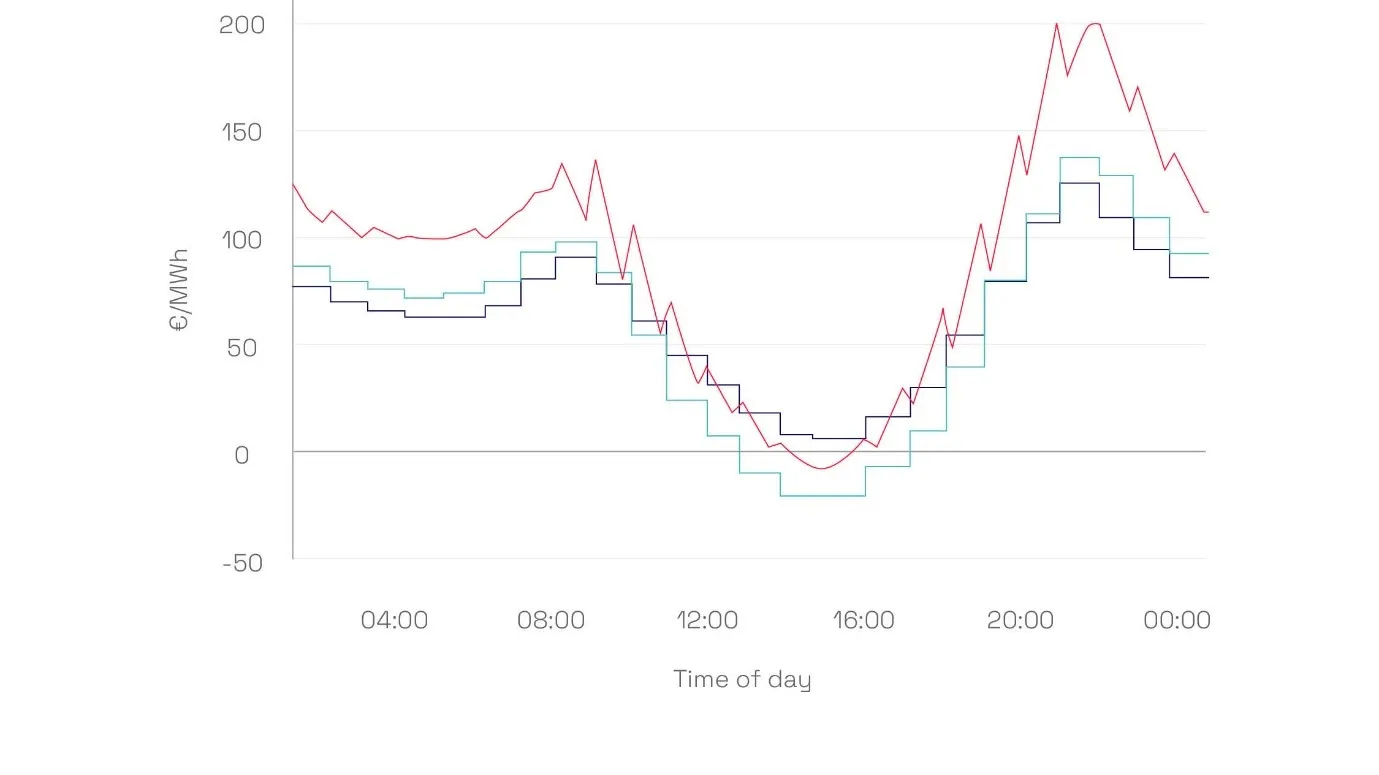
During the day, supply regularly exceeds demand. The wholesale price can then drop to zero or even below zero. This creates negative injection tariffs, where you pay for the electricity you feed back into the grid.
After sunset, we see a different scenario. Other energy sources must ramp up sharply in a short time. Nuclear power plants are built for stable, continuous output and cannot easily follow that swing. As a result, gas power plants often have to step in, which translates into price peaks in the evening.
Traffic jams on the grid
The duck curve doesn't just cause price fluctuations; it also shows where the grid itself is reaching its limits. During grid congestion, a kind of traffic jam forms on the grid: at certain moments, for example in the afternoon when solar production is high, there isn't enough capacity to transport all the electricity, even though there is theoretically enough available. On the low-voltage grid, a lot of simultaneous solar production can push up the local voltage, until an inverter temporarily shuts down for safety reasons.
Batteries are flattening the curve in California and Australia
The duck curve isn't evolving the same way everywhere. Australian energy expert Steve Blume aptly summed up what's happening in Australia: the duck's belly is losing weight, and its head is being cut off. This is because batteries are increasingly leaving their mark on the market there. Surplus solar production is stored in the afternoon and redeployed in the evening, once the sun disappears.
California, too, shows how quickly this shift can happen. Ten years ago, the grid had barely 61 megawatts of battery capacity; today that figure exceeds 16 gigawatts. That leap in scale allowed the state, in May 2026, to source more than half of its electricity from solar power for an entire month for the first time anywhere in the world: 31 consecutive days averaging 51%.
Europe is feeling the price peaks increasingly
In Europe, and thus also in Belgium, we're currently still seeing the opposite effect: the curve is getting sharper. A few examples:
- Germany (ENTSO-E): the evening peak (6pm–9pm) rose from €110 to €156/MWh in two years, an increase of 42%. The gap between the cheapest and most expensive hours of the day grew by 60%.
- Belgium (Elia, Q2 April–June): the average remained relatively stable (€92.8/MWh in 2023 vs. €94.1/MWh in 2026), but the extremes diverged completely: from -€90/+€208/MWh in 2023 to -€499/+€973/MWh in 2026. Same average, a completely different reality.
Investments in batteries are already largely absorbing these extremes in California and Australia. Europe still has that road ahead of it. Companies that can steer or shift their consumption stand to benefit.
What your business can already do today
The impact of the duck curve on electricity prices doesn't have to be a threat for businesses. Companies that can shift their consumption or smartly control their assets turn a cost item into a competitive advantage.
Instead of consuming energy at fixed times, let your assets respond automatically to what the market indicates at any given moment: a battery that charges as soon as the sun increases supply and pushes the price down, and discharges as soon as demand picks up again in the evening; a process that seeks out the cheapest moment of the day on its own, without anyone needing to watch it continuously.
The greater the difference between the cheapest and most expensive hours of the day becomes, the more valuable that steering becomes. In Europe, the duck curve will get sharper still in the coming years before it flattens out again. Companies that invest in smart steering today are already building the flexibility that will count tomorrow.
Related insights

Energy prices in a volatile market
Your contract, consumption data and flexibility together determine your final energy price.

Video: How do we keep the electricity grid in balance?
The electricity grid does not stay in balance on its own. Watch how forecasting, flexibility and fast control keep the system in equilibrium.

The 4 pitfalls of the energy transition
The four biggest pitfalls of the energy transition for industry, and how to turn them into opportunities.