
Energy prices in a volatile market
The final price you pay for your energy is never determined by a single factor.

Prefer watching over reading? Discover the video here.
The amount at the bottom of your invoice results from an interplay of market prices, the type of contract you choose, how your consumption is measured, and above all, the ability to shift your consumption over time. In a volatile market, not everyone pays the same price for the same electricity. Not even on the same day.
Key takeaways
- The wholesale price is formed on the market, but your invoice depends first and foremost on the type of contract you choose: fixed, variable, or dynamic.
- With a variable energy contract, you typically pay an average market price, not your actual consumption per quarter-hour.
- With a dynamic contract, your actual consumption is linked to the current market price.
- Those who can steer their consumption avoid expensive peak hours and make better use of off-peak or even negative price hours.
- In a market with growing grid pressure and congestion, flexibility isn't a luxury, it's common sense.
What price are you paying?
When people talk about “the energy price,” they sometimes lump different things together. The core principle, however, is simple: there is a market price for electricity, but the price you ultimately pay depends on the path that market price takes to reach your invoice. “It's understandable that the confusion starts right there,” says Thomas Van Broeck, CEO of Strado Group. “The market can move sharply from hour to hour, or even quarter-hour to quarter-hour, but not every contract passes that movement on to the end customer in the same way.”
How is the market formed?
The market price emerges where supply and demand meet. Energy producers offer electricity, buyers or suppliers purchase it, and the price is determined by which production is needed at that moment to keep the market in balance. “For day-ahead electricity, this happens through an auction mechanism,” Thomas explains. “EPEX SPOT publishes the so-called market clearing prices for, among others, the Belgian day-ahead market. In other words, not every megawatt-hour costs the same. The final price for a given hour depends on which plants or sources are still needed at that moment, and how tight or ample the system is.”
In a volatile market, the energy price is no longer a fixed given, it's the result of timing. When you shift your consumption, the price stops being something you simply undergo and becomes a lever you actively control.

Why does your contract type make such a big difference?
Fixed, variable, or dynamic: the same market, three completely different logics. Here's an overview of the differences and their impact on your final bill:
Fixed
Your energy price is set in advance for the entire contract period
Advantage: you enjoy maximum price certainty and know exactly where you stand.
Disadvantage: you usually pay a premium for that certainty and don't automatically benefit from falling market prices
Variable
Your energy price is periodically adjusted based on a market index
Advantage: your price tracks the market more closely than with a fixed contract.
Disadvantage: you have little influence over when your price is adjusted and respond only to a limited extent to price fluctuations.
Dynamic
Your price is linked to the current market price at the time of your consumption (e.g., per hour)
Advantage: you can save by shifting your consumption to cheaper moments.
Disadvantage: to get the most out of this contract, you need to be able to actively monitor and steer your energy consumption.
In short: with a fixed contract, you're mainly buying certainty. The supplier factors in possible future price fluctuations and builds that uncertainty into the price. That gives you peace of mind and predictability, but it also means you pay for that protection. With a variable contract, your price tracks the market a bit more closely, though rarely based on your actual consumption moments. So you move with the market, but you have little influence over when you consume energy and what price you pay for it.
Why are dynamic contracts so popular?
In May 2026, the Flemish Energy Regulator reported that a dynamic contract was once again, in 2025, the cheapest electricity contract in Flanders. The report also noted 520 hours of negative prices and an average gap between the highest and lowest hourly price of as much as 110 euros per day.
“It makes sense, then, that dynamic contracts are gaining more and more ground,” explains Matthias Detremmerie, Director at Strado Group. “A variable contract sounds market-driven, but that's only partly true. Many formulas work with an average price and a standard consumption profile, rather than what you consume every quarter-hour. A dynamic contract works differently. Your actual consumption is linked to the price at the moment you consume it, provided your digital meter transmits quarter-hourly data. Fluvius describes this quarter-hourly data as the basis for, among other things, dynamic contracts, and notes that in Flanders this happens through the SMR3 metering regime. That's where the real difference lies. When prices are temporarily high and you can shift or limit your consumption at that moment, you feel it immediately.”
Should you switch right away?
You don't need to overhaul your entire operation overnight. Taking control of your consumption can start with just a few smart shifts.
Think of:
- charging vehicles outside peak hours
- starting processes earlier or later
- deploying batteries strategically
- aligning local consumption with cheaper market hours
- integrating automatic control
That last point in particular adds real value over time. The price then stops being a passive outcome and becomes a signal you can respond to.
In a volatile market, energy isn't just a purchasing question anymore, it's also a matter of control. Those who can avoid expensive hours feel it immediately on their energy bill.

What does this mean for the future?
Forward-thinking companies look beyond simply chasing the lowest energy price. They build insight into their consumption, make use of available data, and explore how to steer their energy use. The final cost of energy is increasingly determined by the combination of market mechanisms and how your company responds to them. Companies that invest in flexibility today gain more control over tomorrow's energy costs.
Related insights
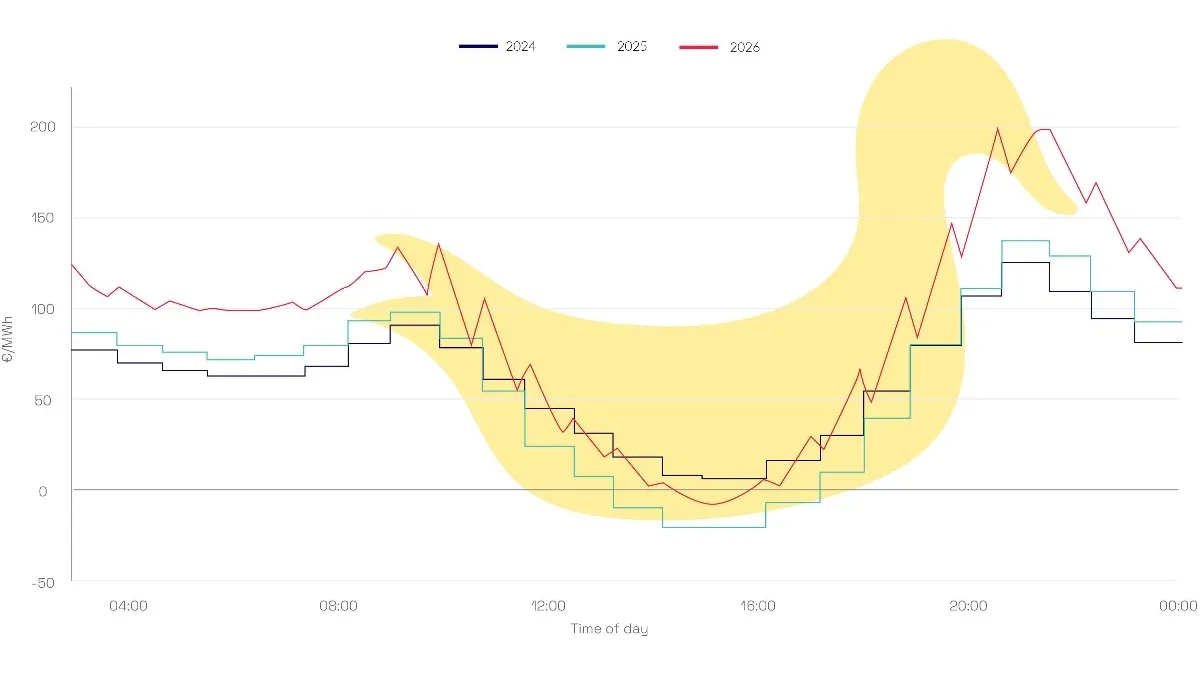
Why the duck curve is shrinking in Australia, while it's getting sharper in Europe
Batteries are flattening the duck curve in Australia and California, while price swings in Europe and Belgium keep growing. Discover why flexibility is becoming increasingly valuable and how your business can take advantage of it today.

Video: How do we keep the electricity grid in balance?
The electricity grid does not stay in balance on its own. Watch how forecasting, flexibility and fast control keep the system in equilibrium.

The 4 pitfalls of the energy transition
The four biggest pitfalls of the energy transition for industry, and how to turn them into opportunities.