The electricity grid: a matter of balance
The electricity grid does not stay in balance on its own. Behind the scenes, that balance is constantly monitored and adjusted in layers that show why forecasting, flexibility and fast control are so vital to an energy system that actually works. Sounds far removed from your day-to-day? Matthias Detremmerie, Director Strado Group, explains why you should pay attention anyway.

Prefer watching over reading? Discover the video here.
In short
- The grid stays in balance through three consecutive steps: nominating, adjusting intraday and balancing at the last moment.
- Transmission system operator Elia monitors the grid frequency of 50 hertz and activates various types of reserves to do so.
- Imbalance is a cost when expectations and reality diverge, but it also creates opportunities for flexibility.
- The better the forecast, the smaller the gap between expectation and reality.
- Batteries and other flexible assets play a role mainly when fast or targeted corrections are needed.
Why is the balance between production and consumption so important?
On a large scale, electricity cannot simply be stored. Production and consumption need to match almost exactly at every moment to keep the electricity grid stable. You do not see that balance directly, but it shows up in the grid frequency.
“In the European electricity system, that sits around 50 hertz,” Matthias explains. “When production and consumption diverge, that frequency changes. For grid operator Elia, that is an important signal to intervene. It sounds complex, but the conclusion is actually simple: energy is not just about how much electricity is produced or consumed, it is also about the timing of when the two come together.”
How does that balance come about?
The first step happens through planning. Market parties indicate in advance how much electricity they expect to produce or take off. Based on that, supply and demand are matched as closely as possible in the day-ahead phase.
“That planning is obviously not a crystal ball,” Matthias says. “It is a well-founded estimate based on, among other things, consumption, production, weather data and portfolio knowledge. That is why forecasting plays such an important role. The better the forecast, the smaller the gap between what was expected and what happened. And the less correction work is needed afterwards.”
Imbalance is not a disruption on the sidelines. It is the point where forecasting, flexibility and market logic come together.

What if the plan does not match reality?
“That is where intraday comes in,” Matthias replies. “That phase gives suppliers and Balance Responsible Parties (BRPs) the chance to adjust their position during the day once it becomes clear their portfolio is deviating from their original nomination. Think of it as the last chance to correct before the system itself steps in. On the European electricity market, alongside the day-ahead auction, there are also intraday markets, including continuous trading right up until close to delivery. In practice, that absorbs many day-to-day deviations. Solar output comes in lower than forecast, a production process needs more energy than expected, or an asset behaves differently than planned: through intraday, parties can still adjust their position and already smooth out part of the gap.”
And what if there is still a gap?
Then we are talking about imbalance. The remaining mismatch at the moment itself, so to speak. Everything not resolved by planning and intraday corrections still needs to be absorbed in real time to keep the grid stable.
“That is also where the economic incentive comes in,” Matthias notes. “Imbalance has a price. Whoever is structurally off feels that. Something to avoid, in other words. At the same time, the need for balancing creates opportunities for parties that can respond flexibly. So, it is a misconception that imbalance is only a cost.”
Which reserves does Elia use to keep the grid stable?
Not one reserve, but an entire chain of responses. Elia deploys different balancing services, depending on the speed and size of a deviation:
- FCR: immediately contains frequency deviations
- aFRR: makes further adjustments to restore frequency
- mFRR: corrects larger or targeted deviations over longer periods
“FCR (Frequency Containment Reserve) is essentially the first line of defense,” Matthias explains. “With aFRR, Elia automatically sends a reference value every four seconds. mFRR is activated manually when larger corrections are needed. The short version: the system first tries to limit deviations automatically, then a chain of reserves follows with more targeted means to safeguard stability.”
What role do batteries and flexibility play?
A significant one, although flexibility is broader than batteries alone. Matthias: “Batteries are particularly well suited to fast reactions, which makes them strong for services like FCR and other forms of fast balancing flexibility. But shiftable consumption, charging infrastructure, thermal buffers and smartly controlled production also help reduce deviations or correct them more precisely. That is where the real system value lies. Flexibility is not just a technical trick, it is a way to narrow the gap between forecast and reality, or to respond to it at the right moment.”
Does that control end up on the invoice?
“Once volumes are actively controlled, the commercial and contractual translation obviously needs to line up too,” Matthias explains. “Imbalance is settled by Elia with the supplier or BRP, while explicit flexibility services often run through external parties that receive the remuneration first. For companies offering flexibility, it is therefore important to be clear on how that value is passed on and paid. Contract, invoicing and data processing need to be properly aligned. That is a layer that is still underestimated in many flexibility projects. Technology can work perfectly, but without a clear commercial structure, part of the value stays untapped. Put simply: if the money flow is not properly set out on paper, the margin stays on the table.”
What does this tell us about the broader energy value chain?
The grid does not stay in balance because of one smart market or one powerful asset. It works because planning, trading, balancing and invoicing connect with each other. “That is also why we prefer to look at the energy value chain as a whole,” Matthias stresses. “Anyone who only looks at production, price or hardware only sees a fragment. The real return sits in the links in between.”
Related insights

Energy prices in a volatile market
Your contract, consumption data and flexibility together determine your final energy price.
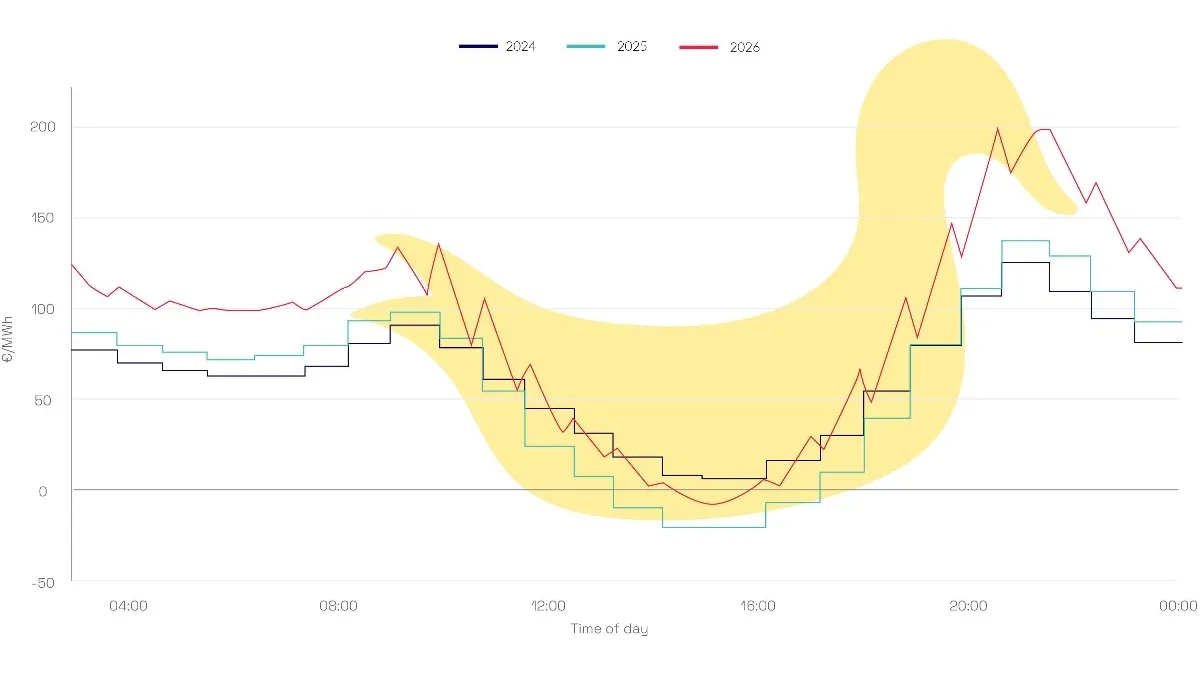
Why the duck curve is shrinking in Australia, while it's getting sharper in Europe
Batteries are flattening the duck curve in Australia and California, while price swings in Europe and Belgium keep growing. Discover why flexibility is becoming increasingly valuable and how your business can take advantage of it today.

Video: How do we keep the electricity grid in balance?
The electricity grid does not stay in balance on its own. Watch how forecasting, flexibility and fast control keep the system in equilibrium.