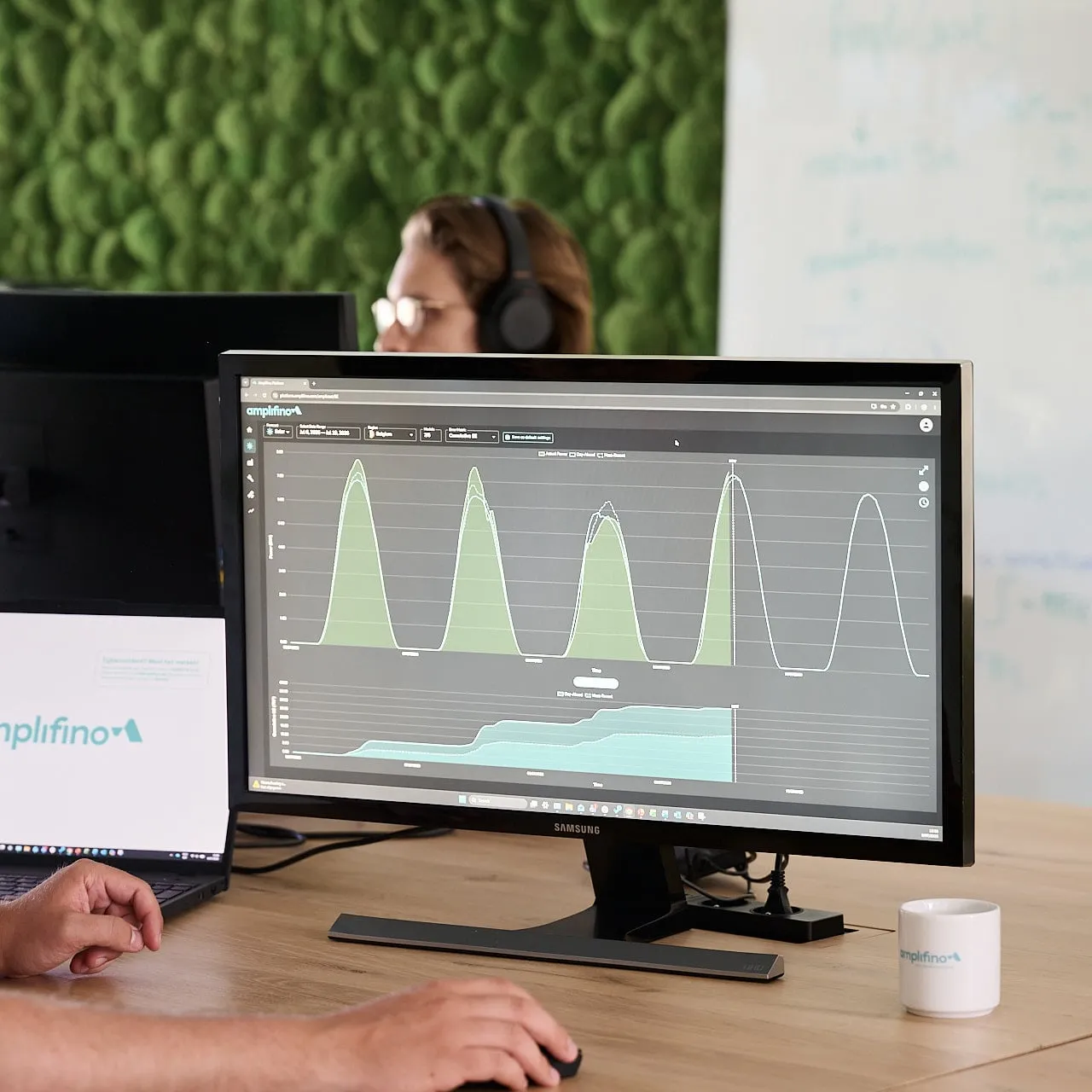
Forecasting software: the quiet engine of your energy chain
Forecasting software goes well beyond predicting how much energy you'll need or produce tomorrow. Director of Amplifino Joost Bruneel explains why a good forecast keeps growing in importance on a dynamic energy market.

Prefer watching over reading? Discover the video here.
Forecasting software forms the basis for a smarter energy chain: from purchasing and trading decisions to battery control and asset optimisation. Without a solid forecast, you buy too late, you steer blind and volatility quickly turns into an expensive habit.
The essentials in one minute
- Forecasting software makes day-ahead energy purchasing possible and so limits extreme exposure to real-time imbalance prices.
- It turns weather, consumption and production data into usable forecasts for suppliers, asset owners and control systems.
- On a market with plenty of wind and sun, forecasting is not a nice-to-have but a condition for keeping your energy chain stable and profitable.
- The strongest forecasts give not just a single expectation, but also the margin of uncertainty around it.
What role does forecasting software play in your energy approach?
Forecasting software is the quiet force behind your energy chain. It predicts how much energy will be consumed, produced, injected or drawn off. That information forms the basis for decisions further down the chain. “A forecast usually stays in the background, but it does determine which choices are possible,” Joost explains. “Without that underlying layer, energy purchasing, trading and control become far harder. Or worse still: a leap in the dark.”
So forecasting first, buying energy second?
Anyone who only buys energy at the last moment exposes themselves to real-time imbalance prices. That is exactly the price level where volatility can hit hard, whereas the day-ahead market is meant to lock in volumes ahead of time through a daily auction. “That is why forecasting plays such a fundamental role,” Joost says. “The forecast shows how much energy will probably be needed, so that a supplier or BRP can buy in advance instead of putting out (expensive) fires afterwards. Think of it as a form of protection against price peaks. Not watertight, but sensible and reassuring. No more stress and chasing after the facts. On the energy market, that is worth a great deal.”
Here is how forecasting turns volatility into grip:
Role of forecasting | What forecasting makes possible | Effect on the chain |
Energy purchasing | Estimate volumes in advance | Less exposure to extreme real-time prices |
Portfolio management | Plan expected offtake and injection | Better balance between forecast and reality |
Asset control | Anticipate production and consumption | Smarter battery, charging or consumption control |
Why is forecasting more complex than it used to be?
Forecasting used to be relatively straightforward. For many consumption profiles, the day type, opening hours and temperature were enough to build a usable day-ahead forecast. “That basis stays important, but the market has changed thoroughly,” Joost says. “As soon as sun and wind make up a larger share of the energy profile, forecasting has to understand both consumption and production. That fundamentally changes the model, of course. On a sunny day, the injection into a portfolio can suddenly be far greater than the offtake. A classic consumption forecast gets you nowhere then. You also have to predict accurately how much sun and wind will actually be converted into power.”
Forecasting does not turn uncertainty into certainty, but it does create a basis for making better decisions.

But a weather forecast is not the same as an energy forecast, is it?
That is where the technical value of forecasting software rises to the surface. “Specialised models combine different data, such as solar irradiance, wind speed, wind direction, temperature and humidity,” Joost explains. “That information is translated into an expected energy production for a specific asset or site. So the software looks not only at the weather, but also at the way an installation, with its own specific characteristics and limitations, responds to it. That skill is what sets usable energy intelligence apart from general meteorology.”
How does a forecast actually become usable for optimisation?
Accuracy is one thing; putting a forecast to work in practice takes far more than a neat line on a dashboard. We distinguish two types of forecast:
- Point forecast: a single predicted value at a given moment, for example an expected production of 100 megawatts at 12:00.
- Probabilistic forecast: an expected value with a range, so including uncertainty and scenarios.
That second form is gaining importance. It shows how likely it is that reality will deviate from the expectation. For battery control and other flexible assets, that is especially valuable. An algorithm can then take different scenarios into account instead of acting as if the future is entirely fixed.
How does forecasting support the other links within Strado Group?
Forecasting does not stand apart from the rest of the energy chain. It forms a base layer on which various applications build further. It may not be the loudest, but it is one of the most decisive. Without forecasting there is no solid plan, and without a plan there is no smart control.
Forecasting supports, among other things:
- the party that takes on energy purchasing or balancing responsibility
- suppliers that have to estimate volumes in advance
- the control logic for batteries and other flexible assets
- the plans that determine how an asset follows an expected profile as closely as possible
What if forecasting falters?
“Then unpredictability wins,” Joost concludes. “You buy wrong, you adjust too late and, as a result, you run a greater risk of costly deviations. Unfortunately, that is still underestimated far too often. Many people still think forecasting is a preparatory step. Reporting up front. In reality, it is decision-making software. It helps determine whether your chain optimises proactively or reacts defensively. Make no mistake: in that last case, the bill often arrives faster than the correction.”
Related insights
Video: What role does forecasting software play in optimising the chain?
Forecasting determines which choices are possible further down the chain. Watch how good predictions turn volatility into grip.
Energy prices in a volatile market
Your contract, consumption data and flexibility together determine your final energy price.
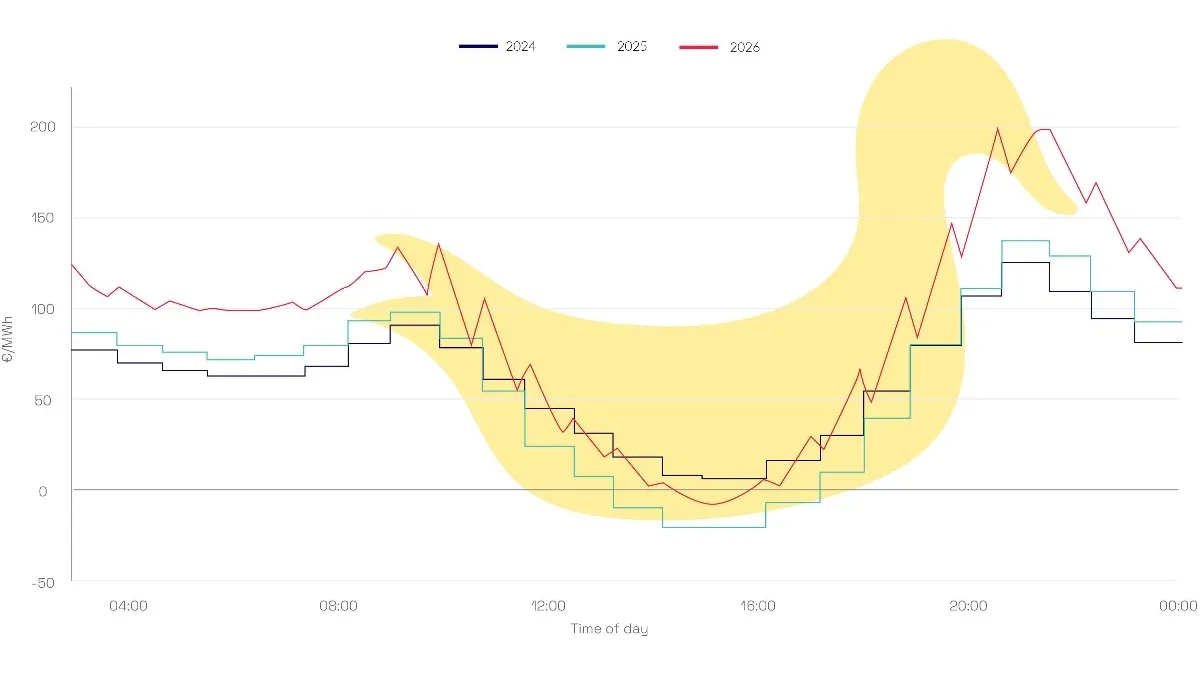
Why the duck curve is shrinking in Australia, while it's getting sharper in Europe
Batteries are flattening the duck curve in Australia and California, while price swings in Europe and Belgium keep growing. Discover why flexibility is becoming increasingly valuable and how your business can take advantage of it today.