
BRP: what does a Balance Responsible Party actually do?
A BRP keeps production and consumption within a portfolio as closely in balance as possible. Straightforward on paper, but behind that balance lies a complex mix of forecasting, market knowledge, and constant fine-tuning. For companies with solar panels, batteries, or dynamic contracts, the role is becoming increasingly relevant. Matthias Detremmerie, Director at Strado Group, explains why.

Prefer watching over reading? Discover the video here.
This article at a glance
A BRP is responsible for balancing a portfolio on the electricity grid.
- A BRP is responsible for balancing a portfolio on the electricity grid.
- It matches supply and demand as closely as possible, every quarter hour.
- Forecasting is essential, because production and consumption are never fully predictable.
- More renewable energy means more variation, and therefore a greater need for solid balance management.
- The quality of a BRP's decisions also affects companies with flexible assets.
What is a Balance Responsible Party?
A Balance Responsible Party, or BRP, is the party responsible to the transmission system operator for the balance within a defined portfolio. In Belgium, this works through a contract with Elia, which requires BRPs to keep their balancing perimeter in balance as closely as possible, every quarter hour. In plain terms: a BRP makes sure that what customers consume, what installations produce, and the positions taken on the market line up as closely as possible. Every 15 minutes.
Is that difficult? And what responsibility does a BRP carry?
The theory sounds simple, but the practice is different. “Carrying out this task requires precise estimates and continuous monitoring,” says Matthias. “And as soon as a quarter-hour estimate differs from reality, an imbalance occurs. That deviation doesn't just have a technical impact on the system, it also carries significant financial consequences, since BRPs are settled based on imbalance prices per quarter hour. So this is far more than a party that simply buys energy. It's the continuous steering of a portfolio in a market where reality is never fully predictable.”
A BRP manages, all at once:
consumption and production forecasts
- consumption and production forecasts
- market positions
- quarter-hour timing
- the financial consequences of deviations

Is forecasting especially crucial?
Without forecasting, a BRP is flying blind. “Anyone who estimates production and consumption too loosely starts every correction already behind,” Matthias explains. “The whole system depends on predicting what's going to happen as accurately as possible. The more accurate that estimate, the smaller the deviation, and the better the portfolio stays under control. And that stakes keeps rising: electricity still can't be stored at scale, which means production and consumption have to be aligned continuously. The value of a BRP therefore doesn't lie only in market access, but above all in its forecasting ability. And in the skill of managing uncertainty.”
Does renewable energy make the job more complex?
Exactly: more sustainable energy is also more dynamic energy. “Sun and wind simply don't always follow what the models predict,” Matthias explains. “A cloud bank moving through faster than expected, or wind output coming in lower than forecast, can throw a portfolio off balance. The more renewable energy sources enter the system, the more often forecasting deviations occur. In a market with more decentralized, weather-dependent production, deep expertise in balance management really makes the difference.”
The leverage doesn't sit in any single activity, but in the way forecasting, trading, and flexibility reinforce one another.

Can anyone become a BRP?
Matthias: “In theory, any party that meets the conditions can take on a BRP role. The catch is that being allowed to, being able to, and actually doing it are three very different things. A BRP must meet contractual, operational, and technical requirements. On top of that, it takes serious knowledge and capacity in forecasting, portfolio management, nominations, and risk management. Don't underestimate that. Estimating, calculating, and acting every quarter hour, 24 hours a day: that's extremely intensive, and an enormous responsibility.”
Who is a BRP relevant for?
A BRP is primarily relevant for suppliers, traders, and other market parties that carry their own responsibility in the value chain, but a BRP's decisions can directly affect your business too. “Companies with a dynamic contract, local production, batteries, or other flexible assets are increasingly affected by balance management,” Matthias points out.
“The quality of forecasting and market steering partly determines how energy is purchased, when a battery gets activated, or where flexibility can create value. That's why understanding the role of a BRP is becoming more important for companies too. It also reflects Strado Group's broader logic: a BRP doesn't operate in isolation from the rest of the energy chain. Forecasting, trading, contract strategy, and asset steering reinforce one another. By looking at these links together, you gain more insight into how to optimize your energy position and extract more value from your flexibility.”
This overview makes that interplay tangible:
Role | What it does | Why it matters |
BRP | Keeps a portfolio of injection and off-take in balance as closely as possible | Limits imbalance and manages system and price risk |
Forecasting | Predicts consumption, production and market behaviour | Forms the basis for every sound balancing decision |
Trading | Adjusts market positions based on signals and expectations | Fine-tunes the portfolio before deviations weigh financially |
Flexibility steering | Smartly deploys batteries, solar PV or other assets | Turns market knowledge into concrete action at asset level |
Related insights

Video: What is a Balance Responsible Party (BRP)?
A BRP keeps production and consumption in balance every quarter-hour. Watch what the role involves and why it matters down to asset level.
Energy prices in a volatile market
Your contract, consumption data and flexibility together determine your final energy price.
Why the duck curve is shrinking in Australia, while it's getting sharper in Europe
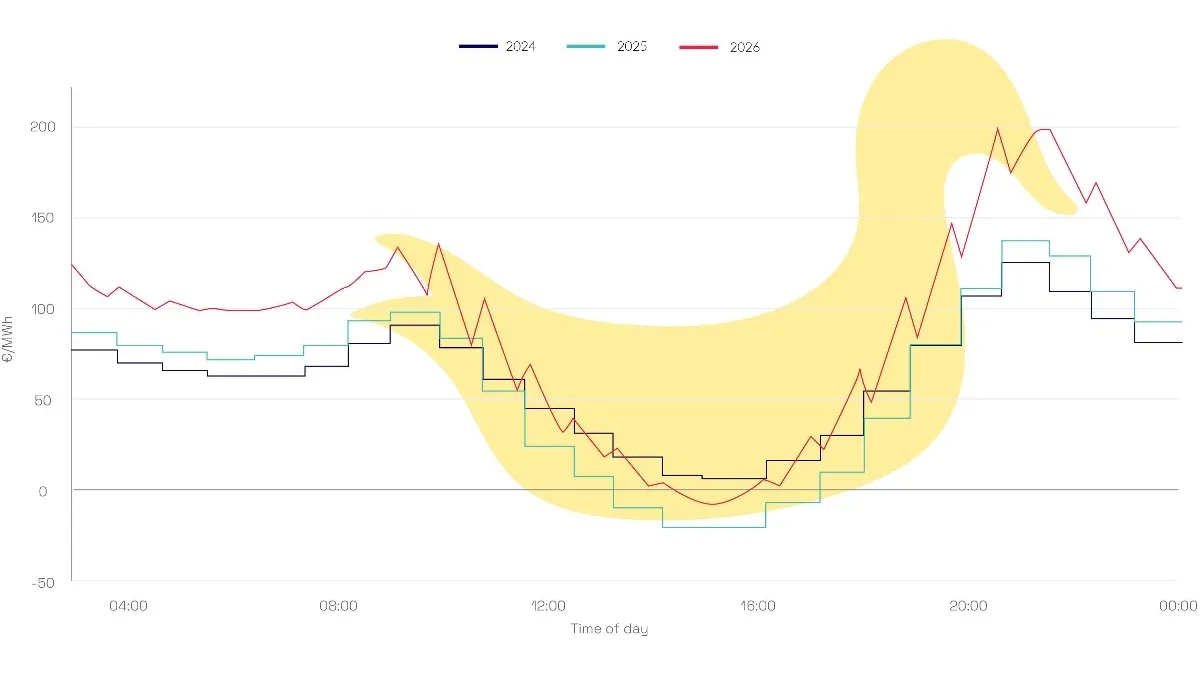
Batteries are flattening the duck curve in Australia and California, while price swings in Europe and Belgium keep growing. Discover why flexibility is becoming increasingly valuable and how your business can take advantage of it today.